

Forbes Is Running Out of Under 30's to Cover
Is this officially the end of founder theatrics?

I’m in Miami this week, although I couldn’t care less about any art as much as I do being hot and getting THEE photo. I’m just honest!
There’s so much happening on the ground, or at least, I assume there is because I haven’t been invited. Who’s doing the work at these PR companies? I’m literally the Slutty Founder. Get real!
Mark these words for next year when I’m at Dior, but for today don’t feel sorry for me. I’m ready to go see about a m*n and a yacht.
What is it about a little sun and humidity that makes me want to act a fool?! And I do mean sexually.
Anyways, on Tuesday I caught up on my feed while my plane was in taxi to see the 2026 Forbes 30 Under 30 came out.
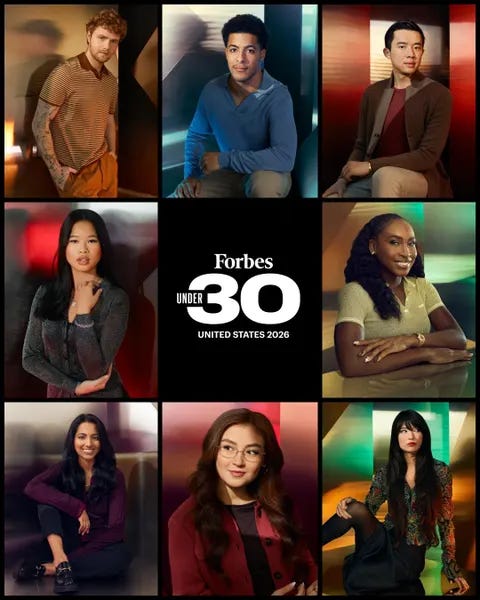

A PR girlie I follow had won, as well as a handful of creators I follow (including Substackers and TikTokers). This intrigued me because it signaled a new direction the list was clearly moving in.
The media and social media categories are somehow separate, which feels both unnecessary and telling.
The discourse around this year’s list has been fascinating, particularly the disappointment.

I, for one, don’t think the list got any worse, I actually think it’s the most honest one we’ve had.
The Death of Founder Mythology
Some time ago, the Forbes 30 Under 30 celebrated 24 year-olds raising $30 million Series As off the strength of a deck and maybe a Stanford rec. That era produced its own mythology, one that encouraged a very specific delusion of success that even I was once heavily invested in.
There once was a time when every birthday made me sick to my stomach, knowing I was creeping closer to the Forbes Under 30 cutoff.
To think this was the type of shit that used to keep me up at night.
But after watching a generation of ‘visionary’ founders collapse under fraud charges, inflated valuations, and fantasy metrics, we can’t even pretend the Forbes 30 Under 30 list still means what it used to.
What The List Actually Reflects Now
The discourse around this year’s list is particularly interesting to me because of the cultural timing, the economic mood, and the collective disappointment.
This year’s list is made up of podcasters, short-form content creators, writers, and people who built audiences first, businesses second—some with no business or product at all.
Whatever aura the accolade used to have evaporated with the times. The cultural conditions that made the list feel aspirational simply don’t exist anymore, and honestly, I’m kind of happy to see it.
As a casual follower of some of the girls who won, I’m happy for them because it’s an achievement I once aspired to myself. Although I’d agree this year’s list does feel particularly lightweight. Not in a bad way, but in a way that’s feels irresponsible for me to ignore.
Perhaps it should be a good thing that the barrier to entry has dropped, and this goal of achieving the Forbes 30 Under 30 is no longer some mythic, untouchable prize. That it feels, at least on paper, more democratic.
It finally reflects the society we actually live in, not the fantasy world of lauding people whose prefrontal cortexes haven’t even fully developed, raising millions to reinvent some bullshit.
The Performance of Competence
This year’s list is a symptom of something bigger in that we’ve fundamentally changed what we’re measuring.
We’re realizing extraordinary competence was never what we were actually rewarding in the first place. The old system that claimed to measure vision and innovation was just measuring who could perform those things most convincingly.
The attention economy has fundamentally shifted the need to be attached to a product, which, if I’m honest is one of many reasons I shut my own company down. The way I was convinced I had to build something to be validated and worthy of being seen and rewarded, instead of just… allowing myself to be seen and rewarded.
You really don’t need the company as the vehicle. Shamelessness alone is enough to bring home the gold.
The attention economy isn’t the only economy that matters, but it’s perhaps the most visibly rewarded. Attention converts to everything now—money, credibility, opportunity, legitimacy.
Even corporate jobs now are rewarding public persona.
Look at Vivian Tu of Your Rich BFF, moving from corporate → creator → corporate again at SoFi.
She’s not an outlier. This year, Forbes included literal employees(!) on their list. I never thought we would see that.
In the age of a 30 second video and the portfolio career, you don’t need to build brick by brick anymore. You just. need. attention.
I think this shift is permanent.
What Forbes Is Actually Rewarding
Forbes itself is responding to this reality.
Contrary to popular belief you actually don’t have to pay or apply to be on this list. I know because I was approached to be on a couple years ago and I couldn’t bring myself to lie about the fact that I had already been 32 for 9 months.
The recent Forbes list is rewarding those who are positioned exactly where attention and trust are flowing. I noticed a shift in coverage which has gone from writing about how much money was raised, to writing about the brand deals Forbes’ honorees have landed.
The Forbes list has become a single node in the economic ouroboros of attention. Content generates attention, attention becomes the product, the product becomes more content, you get more content from the content. You get paid from content, become content in life from your content. The contentification of the list itself is it’s own form of content!
Why the Fantasy Doesn’t Work Anymore
The Forbes 30 Under 30 from five years ago celebrated twenty somethings raising $30 million Series As, promising to revolutionize whatever or tokenize whatever.
We know how those stories ended.
People may want the list to still represent the fantasy, but that requires a suspension of disbelief and history has made us too aware to keep pretending.
The generation who ran companies from that old success model are either all grown up on their third acts or in JAIL. The extreme early success illusion is so played, and I’m not sure how many people are still buying it. That’s precisely why this current list feels so underwhelming compared to those prior—it’s because the mask has fallen.
On Being 30-Something and Still Figuring It Out
Society’s expectations of what we’re supposed to have accomplished by 30 have fundamentally shifted. Maybe that’s just what I tell myself to feel better as someone who’s settled into her thirties and still has a (small) ways to go.
By 35, you’ve presumably lived multiple lives. You’ve pivoted, burned things down, started over... this idea that your twenties are supposed to be your peak achievement years feels like a relic from a different economic reality—one where stability (somewhat) existed and linear career paths made sense.
It should go without saying that it’s never too late.
And this certainly isn’t to diminish what the young people on today’s Forbes list are doing—but the most recent iteration validates a new timeline, one where building an audience is simply enough to count.
Forbes is acknowledging that the definition of success has expanded beyond traditional entrepreneurship. But it also highlights something I think a lot of us are resisting: to be successful now, you must become discoverable, shareable, and watchable. We just have to get over it if we all wanna be rich.
The 30 Under 30 list isn’t worse than it used to be. I think it accurately reflects our broader society in the most truthful way.
Who’s in Miami? Drop me a line if you’re around!
Ta ta!
xox,
SF
I'm months late but, this was a great read!!
This was a great read. Love what you're doing here!