

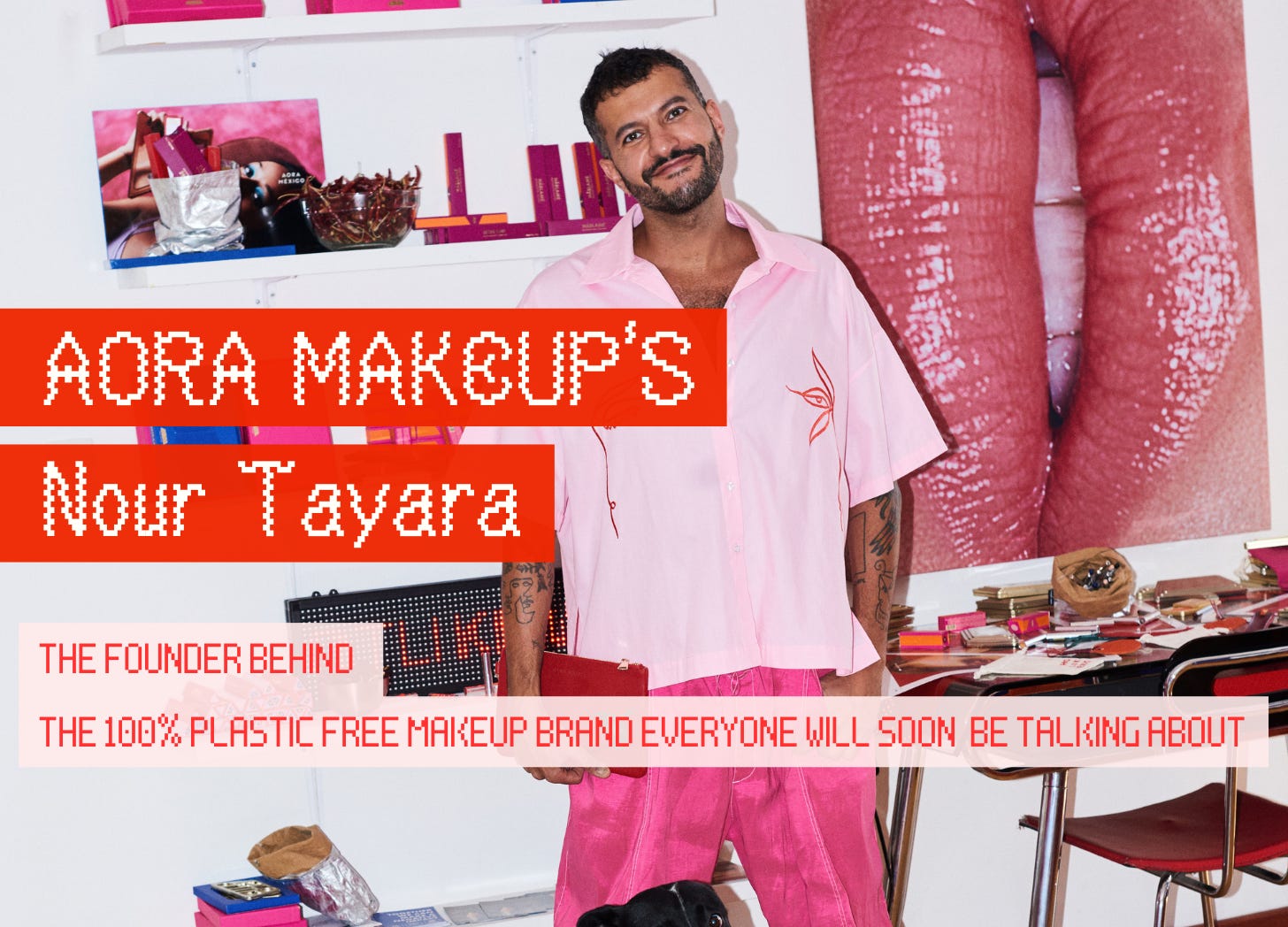
AORA MAKEUP'S Nour Tayara: The founder behind the 100% PLASTIC-FREE brand everyone will soon be talking about
'Rhode of Mexico's' founder talks the queer nudist beach that sparked AORA, almost ignoring a DM to work on Bad Bunny's Superbowl, and being the first to get Sephora to say yes to plastic-free makeup

Slutty Founder is a weekly-ish newsletter from the girl you want to meet in the bathroom (for business advice).

Do not call AORA to a sustainable beauty brand (!!!)
Honestly, it’s almost insulting to think that the brilliance of this brand starts and ends there. Turns out Sephora’s most sustainable beauty brand isn’t trying to sell you on sustainability at all.
In the last year, Mexican-born AORA Makeup has started shifting from an iykyk indie makeup brand to one of the industry’s most talked about newcomers.
Since their 2025 launch in the U.S., some of the brand’s highlights already include serving as the official makeup brand for the performers during the Bad Bunny Superbowl, becoming the first 100% plastic-free brand to enter Sephora and even being referred to ‘The Rhode of Mexico.’
Did I mention they’re bootstrapped?
After completely falling in love with the products when they reached out to me some months ago, I decided it was time I sat down with Nour Tayara—certified hottie, mega Leo (happy b-day Nour!), and co-founder of AORA Makeup. We talked about Beyoncé and the Renaissance that led him here, brushing off a DM to work on the Bad Bunny Superbowl, his thoughts on being called the ‘Rhode of Mexico,’ and why sustainability shouldn’t be the selling point.
I am a fan and know you guys will be too!!!

Anyway, where was I?
So divorce, take all my things, leave my job, decide that I want something else in life. And then one day I met my business partner, naked at [my favorite] beach.
-Nour Tayara, Co-founder AORA Makeup

Nour Tayara co-founder of AORA Makeup | Photo Courtesy of AORA Makeup
SF: What are some jobs you had before becoming a founder?
NT: I studied electrical and computer engineering, and then I moved to Paris.
When I moved to Paris, I started an MBA, and then very quickly started work at L’Oreal. So honestly, most of my career was in the beauty industry, in a big beauty conglomerate around brand building and sustainability in brands.
It really prepared me for having a lot of experience in product development, having learned really from the best to get the right discipline to do very good product because I love the detail behind everything.
Today, you can be cool, you can go viral, you can do great content, you can do whatever you want, but having a very well-made product that stays and passes the test of time, the test of quality, the test of regulations, the test of legal, the test of all of that is hard.
SF: What’s the throughline between you as a Lebanese-born queer Muslim man, working for L’oréal to then starting a Mexican inspired beauty brand? How do those worlds meet?
NT: The easiest answer is Lebanese. We’re all over the place. Colonialism and war takes people from small countries and leave them to figure out how to make the rest of the world home. Lebanon and Mexico have almost 150 years of shared immigration history so Mexico had always been somewhere in the background for me even from a young age.
I grew up in Lebanon, moved to Montreal at 17, Paris at 23, New York at 30, and Mexico at 36. Through most of my adult life, my most special place in the world was a queer nudist beach in the south of Mexico Called Punta Cometa. I used to go every year for almost now 16 years. It’s my happy place. That’s where I go to recharge.
Then during COVID, my life was a bit, crumbling. I needed a sort of life renaissance. And Beyonce came out with Break My Soul.
SF: I think her best album was renaissance.
NT: I mean, I do like Deja Vu.
SF: B’Day?! Omg okay, so that’s my second favorite. That was a really good era for her.
NT: It was. I mean, Get Me Bodied, the extended version…like walk across the floor like Naomi Campbell. Do you remember, all the dances?
SF: Wait, stop. Wait. STOP! Do not play with me right now.
NT: Anyway, where was I? So divorce, take all my things. leave my job, decide that I want something else in life.
I went to my favorite beach. I lived there for about six months. I did my eat, pray, love. And then one day I met my business partner, naked at that beach.
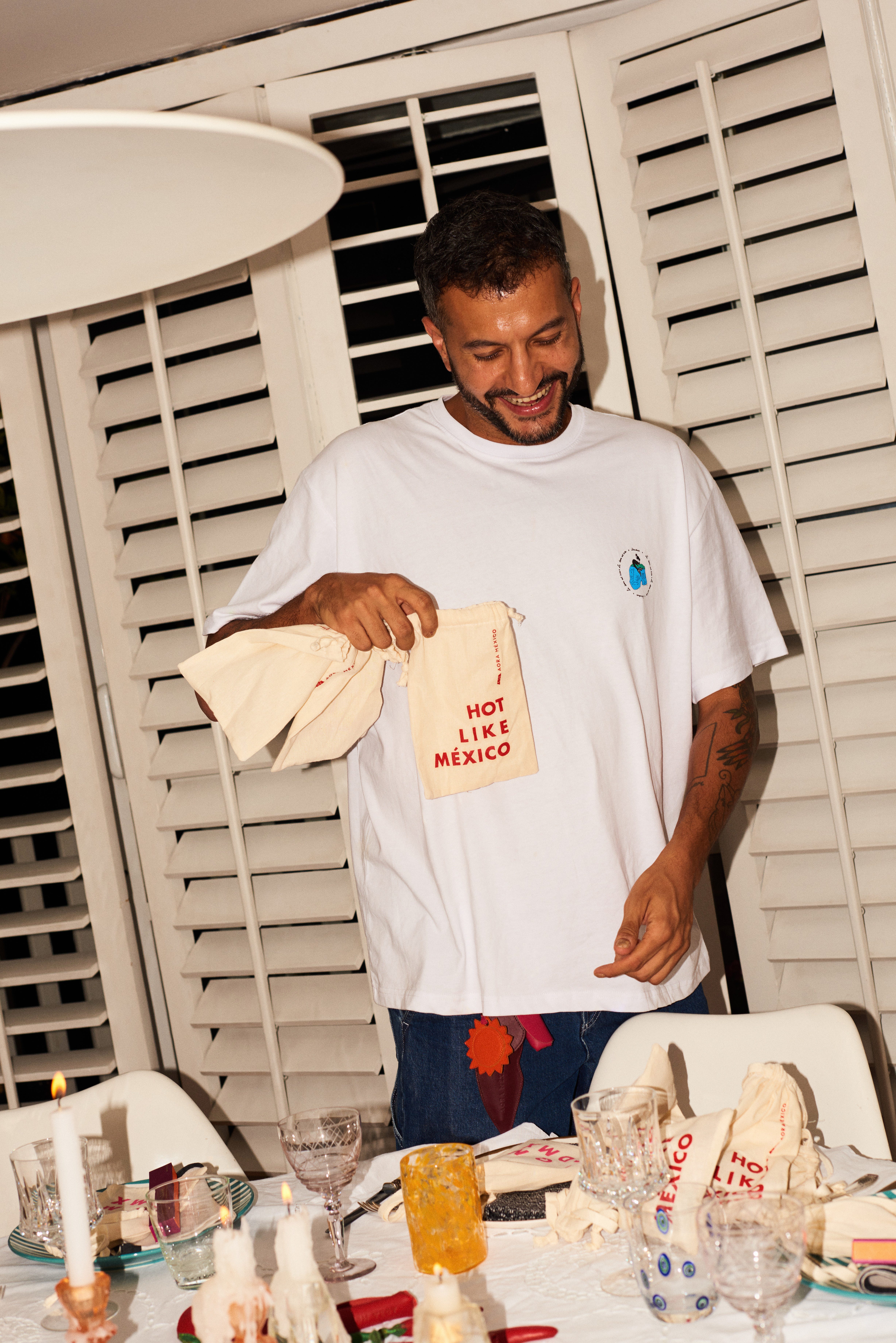
SF: So you and Rodrigo decide to start this brand. What is the first step to making it what it is today?
NT: Research. Research. The first step was actually research. What do we do? What do we stand for? What is Mexico about? I did not want to either steal from or misrepresent the culture. So we spent months on end diving, and researching into identities, colors, visuals, typographies, history. It was fascinating.
SF: How do you feel having been called the Rhode of Mexico?
NT: I’ll take it. Everything helps. I’m in the business of taking visibility. Do I love everything about it [Rhode]? No. It’s growing like crazy, it keeps creating cultural conversations—but they’re not sustainable at all, and I wish someone of that stature would care a bit more. Still that brand is selling because it’s used the power of visuals and emotions to create a cult following. If I can take one thing from that playbook, it’s that we’ve created our own rules, our own universe that people recognize.
SF: When I first saw The Brand Blueprint video, I was like, I love the video, but also — this is totally the PAT MCGRATH of Mexico!
NT: Yes, yes, I agree. But the thing is, I appreciate the Rhode thing because we’re a small brand that needs support, needs funding, all of that. If investors and the world out there can start seeing that there’s a billion dollar opportunity behind the plastic free brand with Spanish on its packaging, I will take it.
So yeah, you want to compare me to one of the biggest exits in the history of makeup? Let’s go.


Inicia Primer | Imagery Courtesy of AORA Makeup
SF: How do you spread the gospel?
NT: I am on a massive press run and it’s so fun because, honestly I’m meeting great people who are becoming friends of the brand. I want to feel like a snowball that is just taking people with us.
My biggest learning of the past 2 years has been that people want to help people, and that at the end of the day, people intrinsically want to do good. No one wakes up and is like, ‘I want to pollute today.’
People intrinsically want to do well and when presented with a solution that is good, they will adopt it. People want to support people not necessarily corporations or brands. That is how I spread the gospel, by showing up very clearly so people want to support me, and thus support the brand. It’s okay to say ‘please support me.’
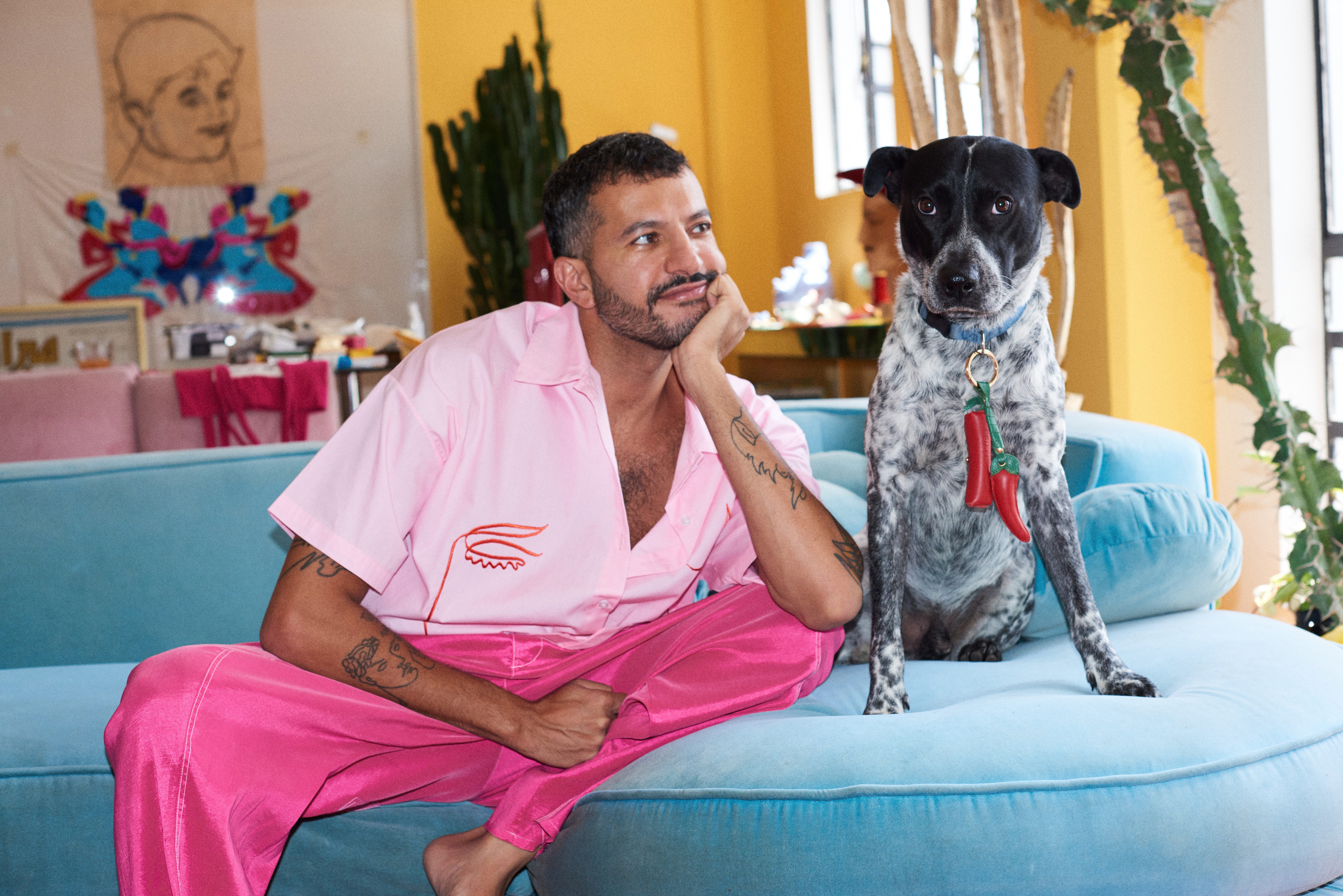
SF: Is there any component of the packaging that is really hard to eliminate plastic from that most brands compromise on?
NT: I mean, look, most brands end up compromising a lot on everything.
Tubes are super, super hard because they’re not as convenient when they’re not in plastic. Tubes are hard because our caps were one of the only caps on the market that is metal on metal. So being able with aluminum to do very small threads, that is where the engineering feat is. It’s much easier and cheaper to go very precise with plastic.
SF: It’s interesting, because I feel like you’re not competing on sustainability.
NT: We are not. I’m so happy you’re saying that.
We’ve won so many awards this year. Not one of them was for sustainable product. You know what I mean? We’re not best actor in a short series. We’re best actor.
The palette won best eyeshadow palette. It didn’t win best eyeshadow palette in plastic-free, sustainable and recyclable category. The primer won best primer.
People don’t buy sustainability because it’s sustainable. People buy it when it gives you a better experience. Organic strawberries are more delicious. It’s not because you’re trying to save a farmer. It’s because they’re made with love by a farmer in great soil, in permaculture, without pesticide.
You don’t buy it because it’s handmade. Because it’s handmade, it ends up having nicer stitching and it lasts longer and it’s more beautiful. I want you to get it because as a consumer, I want you to have a bit more respect for yourself and for your consumption.
SF: Why do you think Sephora bet on AORA?
NT: I think we created a thesis that’s irresistible to retailers. Mexico City is a zeitgeist right now, Spanish has dominated the charts with Rosalia, Bad Bunny, Karol G. — and we’re a sexy brand offering something different, with really good products. So of course they bet on us. We worked hard to be right for a moment in a world of darkness. The world needed fun and color and glitter, not more washed-out beige brands. It needs brands with a sense of creativity, artistry, community, and honestly, politics. Every brand, every choice, every dollar spent is political.


Imagery Courtesy of AORA Makeup
SF: I feel like we’re not talking enough about the Bad Bunny Superbowl. How was it when you got the news. Did you cry?
NT: I cried after it happened. But I did not believe it when I got the news, so I ignored it. It was a DM. I’m like what is this? I’ll get to this later. And then they sent a message to AORA. And my team’s like, Nour. And then it was an email. And then, I’m like OK, maybe this is a bit more serious.
And it wasn’t me trying to be a snob. It was just me being like, this cannot be happening to me, you know? Like, what do you mean the Bad Bunny half time show? I’m like, no way this one thing that the whole world is talking about is happening.
It was like, can you send us a shitload of product by like next Tuesday?
I can’t tell you how surreal watching how beautiful of a show that was. How universal of a show that was. It’s my favorite super Bowl.
SF: It’s my favorite Superbowl.
NT: There’s a before and after Bad Bunny. It happened at the height of darkness, politically and he made the world feel seen. It didn’t matter if you were Latino or not. He spoke to the masses. He spoke to anyone who believes in love and community and dancing and children and celebration and running down the street and being friends with your neighbors and being a good person. That’s what this show was about. It’s not about the makeup. It’s just about being part of a celebration of love and diversity. I can say that we were part of that. Honestly, of course I cried. Are you kidding me?
SF: Do you see your choice to include both English and Spanish on the packaging as a part of the resistance?
NT: Of course. The downward stream would be to put English and French, because legally that’s what you’re supposed to be doing so that you can launch easily in Canada. But why are we thinking of Canada before thinking that the second most spoken language in this country is Spanish, spoken by over 20% of the country who declare that legally. Probably 20 other percent speak it and are afraid to declare it legally because someone might throw them in a concentration camp.
And it should be on the packaging. And it belongs on packaging all over the country. Not just in beauty. It belongs on a cereal box. And it belongs on so many things front and center and out there. Yeah. I love the intentional choice to do Spanish.


You can shop AORA directly on their website or on Sephora.com
I’m Essence Iman, the mind and voice behind Slutty Founder.
Along with writing this Substack, and trying to garner industry plant allegations, I help people and brands figure out how to grow on the internet.
If you want my help with messaging + creative strategy before expensive launches, retail expansion, fundraising or creative moments: here are this month’s OFFICE HOURS
To collaborate, submit a role for Inside Jobs, or partner with Slutty Founder you can reach us here.
<333